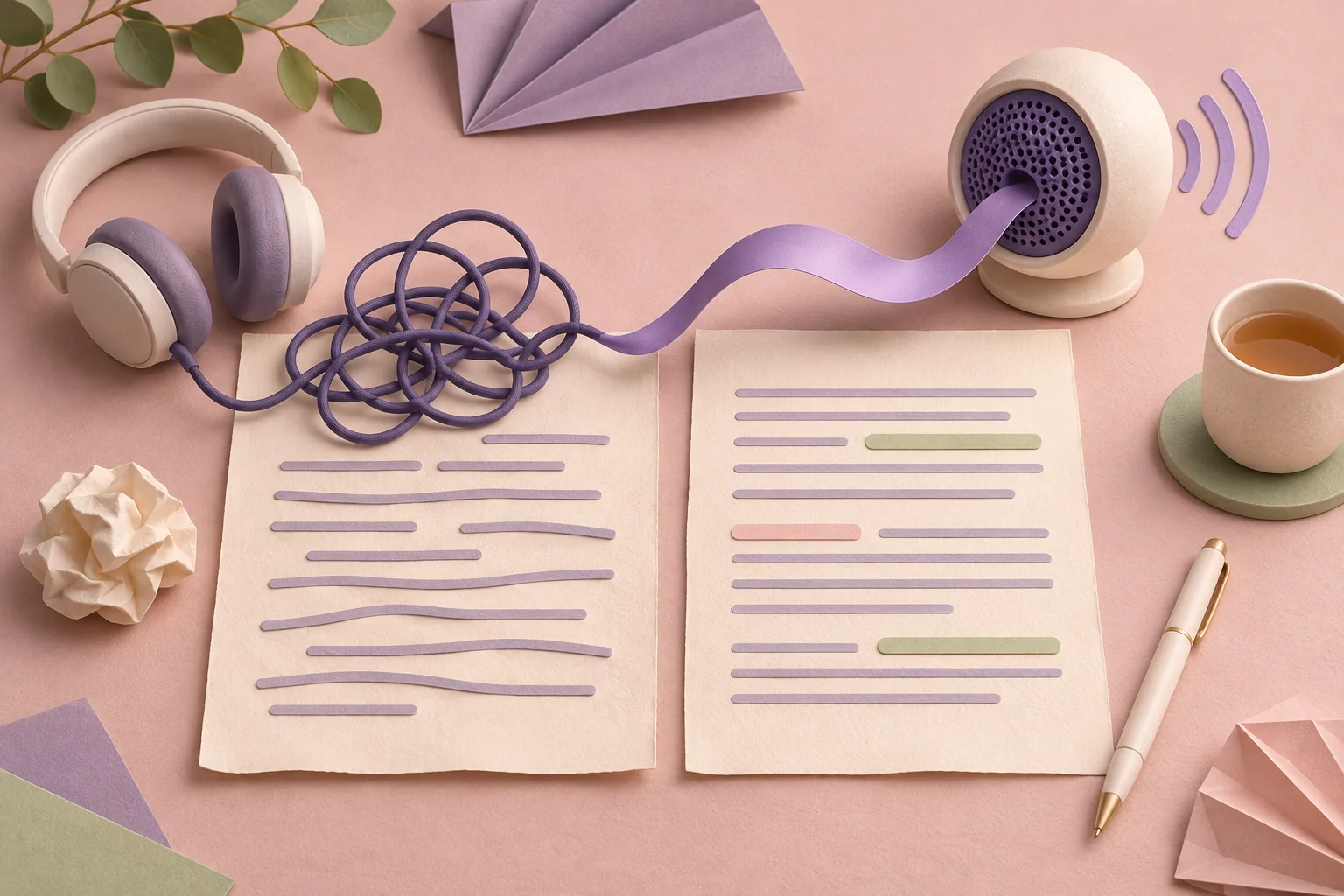
On screen, the sentence looks excellent. It has an elegant opening, two qualifications and a conclusion that appears to hold everything together. Then you hear it and realize how much a listener must remember before reaching the point.
An AI voice can be useful even when the final publication will remain written. It gives you another encounter with your draft, at a pace your eyes cannot quietly accelerate.
Choose a passage with something to prove
Avoid starting with the whole document. Choose the introduction, a difficult explanation or the paragraph connecting two important ideas. A short passage lets you change something and listen again without losing the thread.
In Text to Speech, choose a voice suited to the text’s purpose. For an initial check, a clear reading is often more useful than a highly expressive performance: hear the structure before deciding on the atmosphere.
Keep a copy of the original draft. Comparing versions helps you understand what improved.
Listen for three kinds of difficulty
The first is a sentence that demands too much memory. If the main point arrives after several qualifications, try moving it closer to the beginning.
The second is a transition without a bridge. A heading can make two paragraphs appear connected on the page. In audio, the listener may need a sentence explaining their relationship.
The third is a word chosen for its impression rather than its meaning. If you wrote “operationalizing an iterative approach”, ask whether you mean “try a version, see what works and adjust it”. Preserve precision; question unnecessary complexity.
Revise the idea before directing the voice
When a passage sounds awkward, it is tempting to change the voice or punctuation immediately. Sometimes the sentence itself is trying to do two incompatible jobs.
Separate the explanation from the example. Place the condition before the recommendation. Replace an ambiguous “this” with the right noun. Then listen to the same section again.
Avoid judging a text by a single mispronunciation. Names, abbreviations and specialist vocabulary need a separate check of the generated audio.
Try a reading without the screen
Once you have a clearer version, listen without following the words. Where do you want to go back? Which idea can you repeat when it ends?
Write down three things: what you understood, where you lost the thread and which phrase stayed with you. These notes tell you more than a general impression that the text “sounds good”.
Keep the editorial choice yours
Every piece of writing does not need to sound conversational. An essay can sustain longer sentences; a tutorial may need precise terminology. Listening is an additional test, not a rule that removes your style.
For more on rhythm and transitions, continue with Write for the ear. Sometimes the most useful thing a new voice can do is help you hear your own more clearly.
Put the idea in motion.
Explore how the same recording can become a transcript, a summary and your next creative starting point.
Explore the studio